Best Vitamin C Supplements in India (2026): Top Picks Reviewed & Ranked
As an Amazon Associate we earn from qualifying purchases. We could also earn a fee through some links when you click on them.
Quick Answer
The Limcee Chewable Vitamin C 500 mg at Rs.22.60 a strip is our top pick and the best value here - it is the only listing in the category that prints its actual composition (100 mg ascorbic acid plus 400 mg buffered sodium ascorbate), it is made by Abbott, and it works out at Rs.1.51 a tablet. If you want pharmacopoeial-grade material and full control of your dose, the Bio Balance Sodium Ascorbate Powder at Rs.624 gives you roughly 300 buffered 500 mg servings with nothing else in the tub.

Limcee Chewable Vitamin C 500 mg, Tangy Orange, 15 Chewable Tablets
Rs.22.60
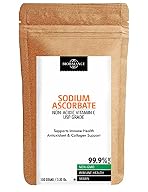
Bio Balance Sodium Ascorbate Vitamin C Powder 150 g, USP Grade
Rs.624
Product Comparison
- Price
- Rs.22.60
- Vitamin C per Serving
- 500 mg (100 mg ascorbic acid + 400 mg sodium ascorbate)
- Vitamin C Form
- Buffered - 80% sodium ascorbate
- Cost per Serving
- Rs.1.51
- Price
- Rs.624
- Vitamin C per Serving
- Self-measured (~300 x 500 mg)
- Vitamin C Form
- Sodium ascorbate (buffered, USP grade)
- Cost per Serving
- Rs.2.08 per 500 mg
- Price
- Rs.486
- Vitamin C per Serving
- 1000 mg ascorbic acid
- Vitamin C Form
- Effervescent ascorbic acid with zinc
- Cost per Serving
- Rs.24.30
- Price
- Rs.423
- Vitamin C per Serving
- 1000 mg (stated as vitamin C, buffered)
- Vitamin C Form
- Buffered tablet (agent not named)
- Cost per Serving
- Rs.14.10
- Price
- Rs.749
- Vitamin C per Serving
- Not disclosed
- Vitamin C Form
- Ascorbic acid with bioflavonoids, rose hips, amla
- Cost per Serving
- Rs.8.32
- Price
- Rs.499
- Vitamin C per Serving
- Not disclosed (1250 mg botanical blend)
- Vitamin C Form
- Amla, acerola cherry, citrus bioflavonoids
- Cost per Serving
- Rs.4.16
- Price
- Rs.948
- Vitamin C per Serving
- Not disclosed
- Vitamin C Form
- Ascorbic acid with rose hips, citrus bioflavonoids
- Cost per Serving
- Rs.5.27
- Price
- Rs.709
- Vitamin C per Serving
- ~65 mg (buyer-reported, not on label)
- Vitamin C Form
- Acerola cherry (whole-food)
- Cost per Serving
- Rs.11.82
| Rating | Product | Price | Vitamin C per Serving | Vitamin C Form | Cost per Serving | |
|---|---|---|---|---|---|---|
| 8.9 | Limcee Chewable Vitamin C 500 mg, Tangy Orange, 15 Chewable Tablets Best OverallBest Value | Rs.22.60 | 500 mg (100 mg ascorbic acid + 400 mg sodium ascorbate) | Buffered - 80% sodium ascorbate | Rs.1.51 | Check Price |
| 8.1 | Bio Balance Sodium Ascorbate Vitamin C Powder 150 g, USP Grade Best Purity Credentials | Rs.624 | Self-measured (~300 x 500 mg) | Sodium ascorbate (buffered, USP grade) | Rs.2.08 per 500 mg | Check Price |
| 7.5 | HealthAid Vitamin C with Zinc, 20 Effervescent Tablets, Sugar-Free, Orange Highest Confirmed Dose | Rs.486 | 1000 mg ascorbic acid | Effervescent ascorbic acid with zinc | Rs.24.30 | Check Price |
| 7.4 | DOCTORS Acid Free Vitamin C 1000 mg, Buffered Vitamin C, 30 Tablets | Rs.423 | 1000 mg (stated as vitamin C, buffered) | Buffered tablet (agent not named) | Rs.14.10 | Check Price |
| 6.6 | Vitaminhaat Vitamin C with Citrus Bioflavonoids, Rose Hips & Amla, 90 Capsules | Rs.749 | Not disclosed | Ascorbic acid with bioflavonoids, rose hips, amla | Rs.8.32 | Check Price |
| 6.5 | Naturyz Double Strength Natural Vitamin C & Zinc with Amla, Acerola Cherry & Citrus… | Rs.499 | Not disclosed (1250 mg botanical blend) | Amla, acerola cherry, citrus bioflavonoids | Rs.4.16 | Check Price |
| 6.4 | EternalHealth Vitamin C (High Potency Form) with Citrus Bioflavonoids & Rose Hips, 180… | Rs.948 | Not disclosed | Ascorbic acid with rose hips, citrus bioflavonoids | Rs.5.27 | Check Price |
| 6.2 | HealthyHey Nutrition 100% Natural Vitamin C from Cherry, 60 Veg Capsules | Rs.709 | ~65 mg (buyer-reported, not on label) | Acerola cherry (whole-food) | Rs.11.82 | Check Price |
Detailed Reviews
Limcee Chewable Vitamin C 500 mg, Tangy Orange, 15 Chewable Tablets
8.9
Excellent

Key Specs
| Vitamin C per Serving | 500 mg (100 mg ascorbic acid + 400 mg sodium ascorbate) |
| Vitamin C Form | Buffered - 80% sodium ascorbate |
| Cost per Serving | Rs.1.51 |
| Count | 15 chewable tablets |
| Item Form | Chewable tablet |
| Flavour | Tangy Orange |
| Manufacturer | Abbott Healthcare Pvt. Ltd. |
| Country of Origin | India |
Pros
- The only product in this entire field that publishes its full quantified composition - 'Ascorbic Acid 100 mg, Sodium Ascorbate 400 mg' - so you know exactly what you are taking
- 80 percent of the dose is buffered sodium ascorbate, far gentler on the stomach than plain ascorbic acid at the same strength
- Made by Abbott Healthcare, a regulated pharmaceutical manufacturer, and routed through Amazon Pharmacy rather than a supplement seller
- At Rs.1.51 per 500 mg tablet it is by far the cheapest genuine vitamin C in tablet form on Amazon.in
- 500 mg per tablet sits far closer to the absorption ceiling than the 1000 mg single doses common in this category, so less of the dose is wasted
- 53 verified India reviews with only 4 critical in the entire product history, and a natural review cadence with no seeding pattern
- Chewable format removes tablet-disintegration risk and needs no water
Cons
- Sold in small 15-tablet strips, so you will re-order often or need to buy multi-packs
- No published Certificate of Analysis, heavy-metal report or USP/NSF-style third-party seal - purity rests on Abbott internal QC alone
- Chewable format requires flavouring and sweetening agents that a plain capsule would not need
- Contains no zinc, bioflavonoids or co-factors if you want a combination product
Our Verdict: In a category where almost every listing hides a 40-65 mg vitamin C dose behind a '1000 mg' amla claim, Limcee simply prints its composition on the label - 100 mg ascorbic acid plus 400 mg sodium ascorbate. That honesty, a genuinely buffered formula from Abbott, and a price of Rs.1.51 a tablet make it the clear pick. The only real drawback is the small 15-tablet strip, which means re-ordering often.
Prices updated at time of publishing. We earn from qualifying purchases.
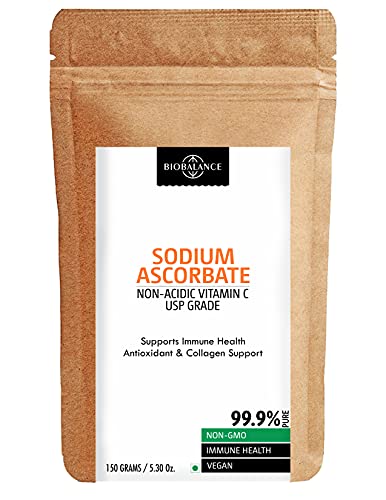
Rs.22.60Bio Balance Sodium Ascorbate Vitamin C Powder 150 g, USP Grade
8.1
Excellent
Key Specs
| Vitamin C per Serving | Self-measured (~300 x 500 mg) |
| Vitamin C Form | Sodium ascorbate (buffered, USP grade) |
| Cost per Serving | Rs.2.08 per 500 mg |
| Count | 150 g powder |
| Additives | None - single ingredient |
| Gluten / GMO | Gluten free, non-GMO |
| Country of Origin | India |
Pros
- Declared USP Grade - the only pharmacopoeial raw-material specification found on any product in this field
- Sodium ascorbate is fully buffered at neutral pH, making it the gentlest option here for anyone with acid reflux, gastritis or a sensitive stomach
- Powder is the only format in this list that lets you set your own dose precisely, including splitting into the smaller portions that absorption research supports
- Roughly 300 servings of 500 mg for Rs.624 - about Rs.2 per serving, the cheapest genuine vitamin C per mg in the whole category
- Single-ingredient product with no colours, sweeteners, flavouring or botanical filler
- Mixes into juice or smoothies and is mild enough that reviewers give it to children and to pets
- Verified buyers with acid reflux and gastric problems specifically report tolerating it where other vitamin C failed
Cons
- One verified buyer received a second pack that was completely oxidised and yellow and had to throw it away - a genuine batch-consistency risk with loose powder
- No verified India review since January 2025 and no positive one since September 2023, so recent batch quality is unvalidated
- No published Certificate of Analysis - the USP claim covers the raw material specification, not a tested finished batch
- Needs a scale or measuring spoon to dose accurately; there is no per-serving convenience
- Sodium ascorbate contributes sodium, which matters on a sodium-restricted diet
- Only 2 units were in stock at the time of research
Our Verdict: If you want real, unadulterated vitamin C and will measure it yourself, this is the most rigorous option on Amazon.in - USP-grade sodium ascorbate at neutral pH, no additives, and roughly Rs.2 per 500 mg serving. It misses the top spot only because no verified Indian buyer has reviewed it since January 2025 and one received a fully oxidised tub, so current batch quality is unproven.
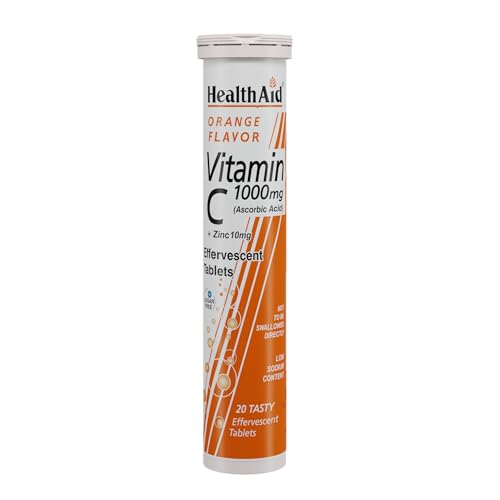
HealthAid Vitamin C with Zinc, 20 Effervescent Tablets, Sugar-Free, Orange
7.5
Great
Key Specs
| Vitamin C per Serving | 1000 mg ascorbic acid |
| Vitamin C Form | Effervescent ascorbic acid with zinc |
| Cost per Serving | Rs.24.30 |
| Count | 20 effervescent tablets |
| Sugar | Sugar-free |
| Manufacturer | Scitech Specialities Pvt. Ltd. (for HealthAid, UK) |
| Country of Origin | India |
Pros
- Delivers a confirmed 1000 mg of actual ascorbic acid, not amla extract weight - a verified buyer specifically bought it after failing to find real ascorbic acid elsewhere on Amazon.in
- Sugar-free, which separates it from most effervescent vitamin C sold in India
- Effervescent tablets dissolve completely, so there is no tablet-disintegration risk
- Zinc included, a genuinely complementary nutrient for immune support
- Zero critical verified India reviews in the product history, and one buyer reports it was recommended by their dermatologist
- HealthAid is a long-established UK supplement brand, made here by a contract pharmaceutical manufacturer
Cons
- At Rs.24.30 per tablet it is the most expensive per-serving option in this list, roughly 16x the cost of Limcee
- Only 8 verified India text reviews across three years - the evidence base is thin
- 1000 mg in a single dose substantially exceeds the roughly 200 mg absorption ceiling, so a meaningful share is excreted rather than used
- No published Certificate of Analysis or third-party seal
- Effervescent tablets carry a sodium load from the carbonate base, which matters if you are watching sodium
- Only 20 tablets per tube, so under three weeks of daily supply
Our Verdict: This is one of the very few effervescent vitamin C products in India built on genuine ascorbic acid rather than a '1000 mg amla extract' claim, and it is sugar-free with zinc added. Verified buyers, including one sent by their dermatologist, are uniformly positive and there is not a single critical review. The catch is cost - Rs.24.30 a tablet is the steepest here.
DOCTORS Acid Free Vitamin C 1000 mg, Buffered Vitamin C, 30 Tablets
7.4
Great

Key Specs
| Vitamin C per Serving | 1000 mg (stated as vitamin C, buffered) |
| Vitamin C Form | Buffered tablet (agent not named) |
| Cost per Serving | Rs.14.10 |
| Count | 30 tablets |
| Positioning | Acid-free / non-acidic |
| Manufacturer | Doctors Medicare Pvt Ltd |
| Country of Origin | India |
Pros
- Explicitly buffered and acid-free, and four independent verified buyers with reflux, gastritis or sensitive stomachs confirm they tolerate it where ordinary vitamin C caused problems
- One buyer notes this formulation is genuinely difficult to find in India, which matches what the rest of this research found
- Stated 1000 mg is described as vitamin C rather than amla extract, with nothing on the listing contradicting it
- Zero critical verified India reviews to date
- A 30-tablet pack gives a full month of daily supply
- Solves the single most common complaint against high-dose vitamin C in Indian reviews - acidity and heartburn
Cons
- The buffering agent is never named on the listing, so the acid-free claim cannot be independently verified from the label
- Only 14 ratings and 7 verified India text reviews, with the listing live only since April 2025
- Two reviews posted a day apart in April 2025 are near-verbatim duplicates, and 5 of the 7 reviews cluster inside one month - the perfect 4.9 star record deserves scepticism
- No published Certificate of Analysis, heavy-metal report or third-party seal
- At Rs.14.10 per tablet it is mid-to-expensive for the category
- No verified review since December 2025, and only 1 unit was in stock at the time of research
Our Verdict: For anyone who has abandoned vitamin C because of acidity or reflux, this is the most directly targeted product in the field, and four independent verified buyers with gastric conditions say it works where others failed. It is held back by a thin and slightly suspicious review record, an unnamed buffering agent and very low stock.
Vitaminhaat Vitamin C with Citrus Bioflavonoids, Rose Hips & Amla, 90 Capsules
6.6
Good

Key Specs
| Vitamin C per Serving | Not disclosed |
| Vitamin C Form | Ascorbic acid with bioflavonoids, rose hips, amla |
| Cost per Serving | Rs.8.32 |
| Count | 90 veg capsules |
| Artificial Colours | None found on listing |
| Manufacturer | Varion Food Sciences Pvt. Ltd. |
| Country of Origin | India |
Pros
- Built on real ascorbic acid, named first in the ingredient list, rather than relying on amla extract weight for its vitamin C claim
- Pairs vitamin C with citrus bioflavonoids and rose hips - the classic complex that traditionally accompanies vitamin C supplementation
- Ingredient list is fully named and clean, with no artificial colours, sweeteners or undisclosed proprietary blend
- 90 capsules gives three months of once-daily supply
- Every verified India text review is positive, including one buyer reporting six months of continuous use
- Steep discount from the Rs.1,599 list price
Cons
- No milligram quantity is disclosed for the ascorbic acid or any other ingredient, so you cannot tell what dose you are taking or judge value per mg
- Only 6 verified India text reviews across nearly three years, and only one in the last 12 months
- 6 percent of lifetime ratings are 1 star but none of those buyers wrote a review, so the reason is unknown
- No published Certificate of Analysis, heavy-metal report or third-party seal
- Amla is present in the blend, which introduces the same extract-weight ambiguity that undermines the rest of this category
Our Verdict: This is one of the few Indian listings that leads with ascorbic acid and adds the bioflavonoids and rose hips that traditionally accompany it, with a genuinely clean ingredient list and three months of supply. What stops it ranking higher is that no quantity is given for anything, so you are trusting the formulation without being able to check it.
Naturyz Double Strength Natural Vitamin C & Zinc with Amla, Acerola Cherry & Citrus Bioflavonoids, 120 Tablets
6.5
Good

Key Specs
| Vitamin C per Serving | Not disclosed (1250 mg botanical blend) |
| Vitamin C Form | Amla, acerola cherry, citrus bioflavonoids |
| Cost per Serving | Rs.4.16 |
| Count | 120 tablets (pack of 2) |
| Added Zinc | 10 mg per tablet |
| Facility | GMP, HACCP & ISO certified |
| Manufacturer | Sofy Healthcare Pvt. Ltd |
| Country of Origin | India |
Pros
- Combines amla with acerola cherry and citrus bioflavonoids - acerola is one of the richest natural vitamin C sources and the bioflavonoids genuinely assist uptake
- Manufactured in a GMP, HACCP and ISO certified facility, the most manufacturing certification any candidate in this field discloses
- Zinc quantity is actually stated at 10 mg per tablet, which most competitors omit
- At Rs.4.16 per tablet across 120 tablets it is among the cheapest options here, giving four months of supply
- The cleanest recent star record of any botanical-sourced vitamin C in this research - only 1 negative in the 20 most recent verified India reviews
- 38 verified India reviews with several multi-year repeat users, including one on their fifth year
Cons
- The actual ascorbic acid content is never disclosed - 'Double Strength 1250 mg' is the combined botanical blend weight, so the real vitamin C figure is unknown and likely a small fraction of it
- Only 1 verified India review in the past 12 months; the review base is dominated by 2021-2022 COVID-era purchases
- One verified buyer objects to the number of synthetic ingredients for a product positioned as natural
- Another reviewer notes it supplies vitamin C but should not be relied on as a broad immunity product
- No published Certificate of Analysis or heavy-metal report despite the facility certifications
- One long-term customer complains about the seller changing pack configuration and pricing practices
Our Verdict: If you specifically want a plant-sourced vitamin C complex, this is the best-executed one in this research - acerola and citrus bioflavonoids alongside amla, made in a GMP/HACCP/ISO facility, at Rs.4.16 a tablet with a genuinely clean recent review record. It still shares the category flaw of never telling you how much ascorbic acid you actually get.
EternalHealth Vitamin C (High Potency Form) with Citrus Bioflavonoids & Rose Hips, 180 Veg Capsules
6.4
Good

Key Specs
| Vitamin C per Serving | Not disclosed |
| Vitamin C Form | Ascorbic acid with rose hips, citrus bioflavonoids |
| Cost per Serving | Rs.5.27 |
| Count | 180 veg capsules |
| Excipients | Rice flour and veg capsule - fully disclosed |
| Artificial Colours | None |
| Manufacturer | EternalHealth |
| Country of Origin | India |
Pros
- Full excipient list is published - ascorbic acid, rose hips, fruit peel, rice flour and a vegetarian capsule - with no artificial colours, sweeteners or undisclosed blend
- Built on real ascorbic acid rather than a botanical extract weight
- Rose hips and citrus bioflavonoids provide the traditional vitamin C complex co-factors
- The brand answers the third-party testing question directly on the listing, citing FSSAI and Drug Controller testing - more disclosure than most competitors offer
- 180 capsules is six months of once-daily supply, the longest in this selection, at Rs.5.27 per capsule
- Lifetime rating histogram shows a genuine spread including a 6 percent 2-star band, which reads as unmanipulated
Cons
- Only one verified India text review exists in the entire product history, so Indian buyer experience is essentially unproven
- 'High Potency Form' is asserted with no milligram figure anywhere on the listing, so the dose is unknown
- The testing cited is regulatory import clearance, not a published batch Certificate of Analysis or heavy-metal report
- At Rs.948 it has the second-highest upfront cost in this list
- Only 1 unit was in stock at the time of research
- No verified India review since July 2024
Our Verdict: On formulation this is one of the better products in the field - real ascorbic acid, rose hips and bioflavonoids, a fully published excipient list with no colours or fillers beyond rice flour, and six months of supply. It ranks low purely because a single verified Indian review in five years means nobody has meaningfully validated it here, and the dose is never stated.
HealthyHey Nutrition 100% Natural Vitamin C from Cherry, 60 Veg Capsules
6.2
Good

Key Specs
| Vitamin C per Serving | ~65 mg (buyer-reported, not on label) |
| Vitamin C Form | Acerola cherry (whole-food) |
| Cost per Serving | Rs.11.82 |
| Count | 60 veg capsules |
| Facility | FSSAI registered |
| Manufacturer | HealthyHey Foods LLP |
| Country of Origin | India |
Pros
- Whole-food acerola cherry vitamin C with the bioflavonoids that naturally accompany it, rather than an isolated synthetic
- The small ~65 mg per capsule dose is actually well suited to splitting intake across the day, which matches how vitamin C absorption works - one reviewer uses it exactly this way
- Single-ingredient product with a clean label and no artificial colours or sweeteners
- Reviewers consistently report it is gentle on sensitive stomachs
- Reasonably well reviewed at 4.5 stars across 123 ratings with 200+ units bought in the past month, so it moves steadily
- Capsules are noted as easy to swallow and well packed
Cons
- At roughly Rs.0.18 per mg of vitamin C it is the worst value in this selection - about 60 times the cost per mg of Limcee
- The listing never states the vitamin C content; the ~65 mg figure comes only from buyers who checked the bottle themselves
- Three independent verified reviewers explicitly complain the dose is far below a useful maintenance level, with one calling it minuscule
- A 65 mg capsule is barely above the ICMR-NIN 80 mg daily requirement, so it tops up rather than supplements meaningfully
- No published Certificate of Analysis or third-party testing - FSSAI registration is baseline compliance only
- Only 2 verified India reviews in the last 12 months, and only 1 unit was in stock at the time of research
Our Verdict: This is real, clean, whole-food vitamin C from acerola cherry, and buyers with sensitive stomachs like it. The problem is arithmetic - at roughly 65 mg per capsule for Rs.11.82 you are paying about sixty times more per milligram than Limcee, and three separate reviewers say so plainly. Worth it only if whole-food sourcing matters more to you than dose or cost.
How We Evaluated
We don’t run a lab — we research, analyse and compare. Vitamin C is an unusually deceptive category to shop in India, because the number printed largest on the pack is almost never the number that matters. So across roughly 35 candidates we worked from verifiable evidence: the form of vitamin C actually named on the label, the milligram figure attached specifically to ascorbic acid rather than to a botanical extract, whatever purity credential the brand could actually point to, the live Amazon.in price converted to a cost per serving, and what verified Indian buyers reported after opening the bottle and reading the panel themselves.
Our scoring weights five criteria. Vitamin C Form & Bioavailability (25%) ranks buffered mineral ascorbates — sodium ascorbate, calcium ascorbate, Ester-C — highest, then genuine liposomal delivery that names a carrier, then plain ascorbic acid, then whole-food botanical sources such as acerola, with amla-only ‘natural vitamin C’ last. Because absorption saturates near 200 mg per dose, a 500 mg split-dose design scores above a 1000 mg mega-tablet. Dose Accuracy & Label Transparency (20%) rewards a clear, internally consistent milligram figure of elemental ascorbic acid, against the ICMR-NIN requirement of 80 mg a day and a 2000 mg upper limit. Purity & Safety (20%) counts only checkable verification — a pharmacopoeial grade, a published Certificate of Analysis, or a recognised finished-product seal. Customer Satisfaction (20%) reads recent verified Indian reviews rather than the lifetime star average. Value for Money (15%) compares cost per milligram of real vitamin C, not the sticker price.
Two adjustments did most of the reordering. Where the headline milligram figure turned out to be amla extract weight rather than ascorbic acid, we scored the product down hard — that single rule removed most of the category’s best-sellers. And where a listing published no milligram figure of any kind, we treated the dose as unknown and capped the score accordingly, however clean the ingredient list and however warm the reviews. Of roughly 35 candidates, only 8 survived.
Buying Guide
The ‘1000 mg’ on the front of the bottle is almost never vitamin C
This is the single most important thing to understand before buying vitamin C in India. On the large majority of listings — including the two best-selling products in the category — the ‘1000 mg’ headline refers to the weight of amla (Indian gooseberry) extract, not ascorbic acid. The actual vitamin C is typically 40 to 80 mg. Verified buyers who opened the bottle and read the nutrition panel report 65 mg on one popular brand, 50 mg on another, 40 mg on a third and 80 mg on a fourth, against 1000 mg claims on all of them. One brand’s own product bullet states it plainly: ‘contains Natural Vitamin C from 1000 mg Amla Extract’. None of this is illegal, and amla genuinely does contain vitamin C — but if you are buying a supplement to correct a deficiency, you are getting roughly one twelfth to one twentieth of the dose you thought. Before you buy, look for a milligram figure attached specifically to the words ‘ascorbic acid’ or ‘vitamin C’, not to ‘amla extract’, ‘blend’ or ‘complex’.
How much you actually need, and why 1000 mg is not twice as good as 500 mg
The ICMR-NIN recommended daily allowance for Indian adults is 80 mg. A supplemental dose of 500 mg comfortably covers deficiency correction for most people, and the tolerable upper limit is 2000 mg a day. The important physiological detail is that vitamin C absorption saturates: at around 200 mg per dose your intestinal transporters are largely maxed out, and above that an increasing share of what you swallow is simply excreted. So a 1000 mg tablet does not deliver 1000 mg to your bloodstream, and two 500 mg doses morning and evening are meaningfully better used by your body than a single 1000 mg hit. It also means the very small doses at the other end of the market — 65 mg acerola capsules, for instance — are not useless, they are just barely more than a daily requirement rather than a supplemental dose. Match the format to the goal: splitting is better, and a product that lets you split is worth more than its milligram count suggests.
If vitamin C gives you acidity, you need a buffered form — not a smaller dose
Acidity, heartburn and reflux are by far the most common genuine complaint in Indian vitamin C reviews, and the usual response — taking less, or giving up — is the wrong fix. Ascorbic acid is, as the name says, an acid. Mineral ascorbates are not: sodium ascorbate and calcium ascorbate are pH-neutral salts of the same vitamin, delivering the same ascorbate ion without the acid load. This shows up clearly in the reviews we analysed. Buyers of the buffered products here report tolerating them specifically where ordinary vitamin C failed, with four independent reviewers of the DOCTORS acid-free product citing pre-existing reflux or gastritis, and Bio Balance buyers citing neutral pH for sensitive stomachs. Look for ‘sodium ascorbate’, ‘calcium ascorbate’, ‘buffered’ or ‘Ester-C’ on the label. Chewables and effervescents help somewhat too, but a genuine mineral ascorbate is the real solution.
What counts as real purity evidence — and why ‘organic’ is not it
Organic certification governs how a crop was farmed. It does not involve testing the finished product for heavy metals. The same applies to ‘natural’, ‘plant-based’ and brand reputation — none of these tell you anything about what is actually in the capsule. Real purity evidence, in descending order of strength, is: a recognised finished-product seal (USP Verified, NSF, Informed Choice); a branded certified raw material such as Quali-C with a per-batch Certificate of Analysis; a published product-specific lab report; a pharmacopoeial raw-material grade such as USP, FCC or Ph. Eur; and finally GMP or ISO facility certification, which assures the process rather than the batch. The honest finding here is that almost nothing in the Indian vitamin C market carries any of the top three. Two products declare a pharmacopoeial grade and one declares GMP plus HACCP plus ISO facility certification; the rest rely on in-house quality control claims alone. That is worth knowing rather than papering over.
Read the ingredient list for colours, sugar and additives before committing to daily use
A supplement you take every morning for a year deserves more ingredient scrutiny than something you take occasionally. Several products in this category carry additives that are easy to miss. One chewable we looked at declares its colour as Sunset Yellow FCF, an artificial azo dye, directly in the Amazon spec table. A popular effervescent contains maltodextrin, which has a glycemic index of 105 to 136 — higher than table sugar — making it a poor choice for diabetics, plus sucralose. Another was flagged by a reviewer for containing sodium benzoate alongside ascorbic acid, a combination capable of forming benzene. Gummies are the worst offenders on sugar: verified buyers describe one popular vitamin C gummy as essentially corn syrup and sugar. Effervescent tablets also carry a substantial sodium load from their carbonate base, which matters with high blood pressure. None of this is hidden — it is just printed somewhere other than the front of the pack.
Check authenticity codes and expiry dates on arrival
Fulfilment integrity is a recurring theme in Indian supplement reviews and it cuts across price points. Verified buyers of one premium direct-selling brand repeatedly reported that pack authenticity codes failed to verify — scratched QR codes, missing verification numbers, scanning that returned nothing — alongside stock months from expiry on arrival. Similar failures were reported on another popular brand, along with oxidised, foul-smelling tablets and inconsistent tablet colour between orders. Loose powder carries its own risk: one buyer received a second pack that had oxidised to yellow and was unusable. When your order arrives, check the manufacture and expiry dates before opening, scan any authenticity QR code the brand provides, confirm the seal is intact, and count the tablets against the stated quantity. If anything is wrong, initiate the return immediately rather than after you have started the bottle.
Who Should Buy a Vitamin C Supplement?
- Anyone eating a low-fruit, reheated-food diet — vitamin C is destroyed by prolonged heat and storage, so a plate that looks vegetable-heavy after an hour in the kadhai and a night in the fridge can still leave you short.
- Vegetarians topping up iron, since vitamin C substantially improves non-haem iron absorption. Taking 500 mg alongside your iron supplement or your dal is one of the few genuinely evidence-backed supplement pairings.
- People who catch every seasonal bug, because vitamin C is central to normal immune function — though it works as daily nutrition, not as a cure for a cold that has already started. Often paired sensibly with zinc.
- Anyone taking collagen for skin or joints, since vitamin C is a required cofactor for collagen synthesis — a collagen supplement without adequate vitamin C is doing half the job.
- Smokers, who have measurably higher vitamin C turnover and a correspondingly higher daily requirement.
- Not for you if you already take a multivitamin delivering a full RDA and eat citrus, amla, guava or capsicum regularly. And if you are buying it purely for skin brightening, a topical serum will do far more than a tablet.
The Bottom Line
For almost everyone, Limcee Chewable Vitamin C 500 mg is the right answer, and it is both our top pick and the best value on this list. It is the only listing in a field of roughly 35 candidates that prints its actual composition — 100 mg ascorbic acid plus 400 mg sodium ascorbate — so you know what you are taking. Eighty percent of that dose is buffered, which is why not one of the 53 verified Indian buyers reports stomach upset. It is made by Abbott and sold through Amazon Pharmacy rather than a supplement reseller. And at Rs.1.51 a tablet it costs roughly a sixtieth per milligram of what the acerola capsules charge. The only genuine annoyance is the 15-tablet strip, so buy multi-packs.
If you want the strongest purity credential available in this market and are happy to measure your own dose, the Bio Balance Sodium Ascorbate Powder is the one to buy: USP-grade, neutral pH, a single ingredient with nothing added, and roughly 300 servings of 500 mg for Rs.624. It is the gentlest option here for reflux or gastritis, and powder is the only format that lets you split intake the way absorption research actually supports. Buy it knowing that no verified Indian buyer has reviewed it since January 2025, and check the tub for yellowing when it arrives.
If acidity is what has stopped you taking vitamin C before, the DOCTORS Acid Free Vitamin C 1000 mg is the most directly targeted product in the field, with four independent verified buyers who have reflux or gastritis confirming they tolerate it — accept that the buffering agent is never named and the review base is thin. And if you specifically want an effervescent with a confirmed real 1000 mg of ascorbic acid rather than amla extract, the sugar-free HealthAid Vitamin C with Zinc is the rare honest one, at Rs.24.30 a tablet. Whatever you pick, do the same two checks first: find a milligram figure attached to the words ‘ascorbic acid’, and if it says amla, put it back.
Frequently Asked Questions
Why does my vitamin C say 1000 mg when reviewers say it only has 65 mg?
Is natural vitamin C from amla better than synthetic ascorbic acid?
Should I take 500 mg or 1000 mg of vitamin C daily?
Which vitamin C is best if I get acidity or acid reflux?
Is liposomal vitamin C worth the extra money in India?
Do vitamin C supplements actually improve skin or reduce pigmentation?
Can I take vitamin C together with zinc, and how much zinc is safe?
How can I tell whether a vitamin C supplement has been properly tested?
References

Reviewed by
Naveen BhavnaniFounder & Lead Reviewer
Founder of Fitness Picks. Researches and compares fitness gear, supplements, and recovery products for the Indian market.
More about Naveen →Related Reviews
Best Zinc Supplements in India (2026): Top Picks Reviewed & Ranked
Most Indian zinc labels shout a salt weight, not the zinc itself - so a '50 mg' bottle can hold 10 mg. We scored 9 zinc supplements on true elemental dose, form, published testing, tolerability and cost per day, and named the ones whose numbers actually add up.
Best Biotin Supplements in India (2026): Top Picks Reviewed & Ranked
That '10,000 mcg' on the front of the pack is usually the weight of Sesbania plant extract, not of biotin - what you swallow is closer to 30 mcg. We scored 26 biotin supplements on dose honesty, manufacturing provenance, side-effect reports and cost per day.
Best Vitamin B12 Supplements in India (2026): Top Picks Reviewed & Ranked
Most 'plant-based' B12 sold in India is pseudovitamin B12 from spirulina or moringa - inactive in humans. We scored 11 supplements on B12 form, the actual mcg dose, purity evidence and cost per day, and named the ones whose label, dose and buyers' blood tests agree.
Best Iron Supplements in India (2026): Top Picks Reviewed & Ranked
Iron-deficiency anaemia is India's most common deficiency, especially in women. We scored and ranked 12 iron supplements on bioavailable form, GI comfort, elemental dose and true per-tablet value — plus why you should test your ferritin before you start.
Best Vitamin K2 Supplements in India (2026): Top Picks Reviewed & Ranked
From India's most-bought everyday D3+K2 to verified all-trans MenaQ7 imports and the lowest-cost standalone MK-7, we scored and ranked 14 vitamin K2 supplements on form and bioavailability, dosage, purity, value and real buyer feedback.
Best Vitamin B-Complex Supplements in India (2026): Top Picks Reviewed & Ranked
From fully methylated active-form capsules to the best-value complete 8-vitamin tablets, we scored and ranked 11 Indian B-complex supplements on formulation, B12 and folate quality, purity, tolerability and true cost per serving — with the vegetarian B12 gap front and centre.